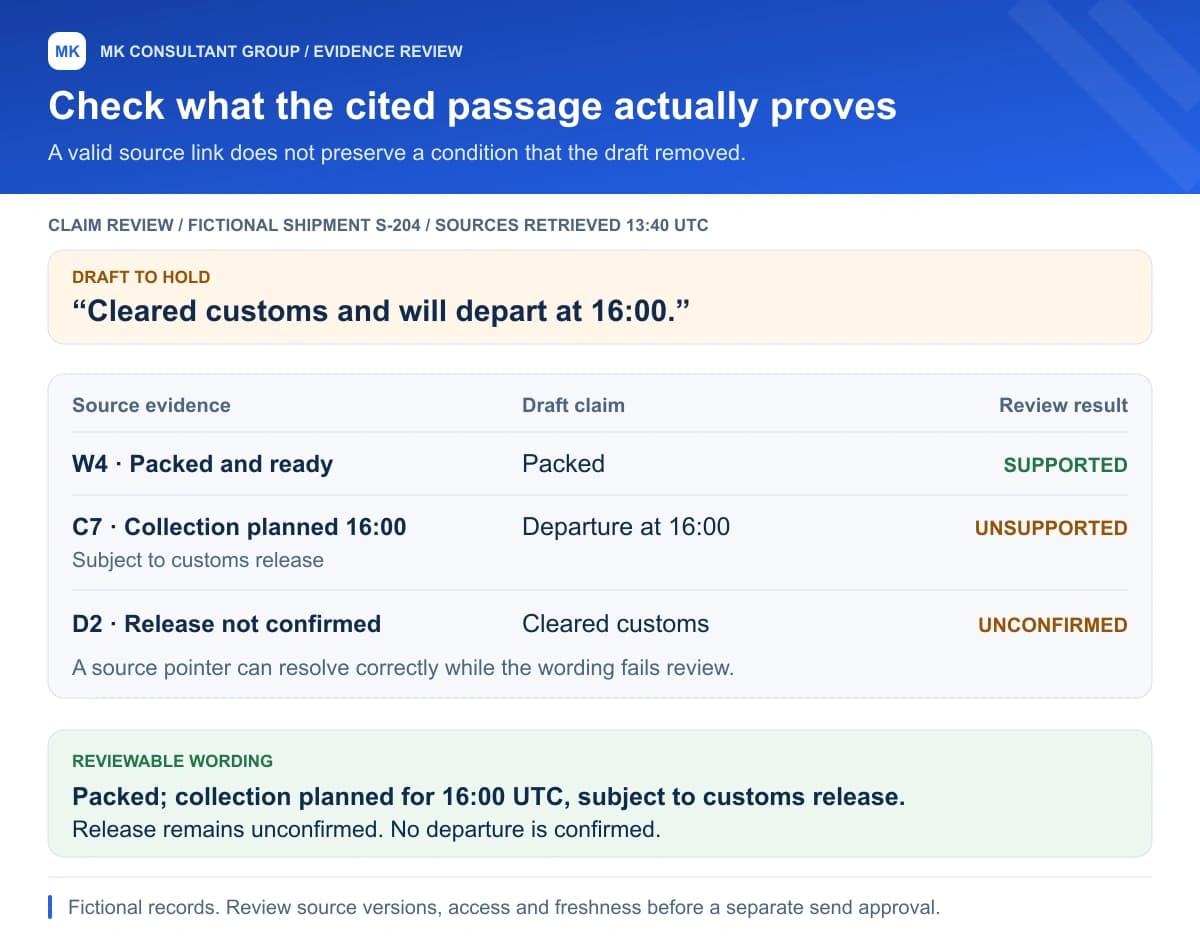
A customer update can link to a real document and still tell the customer something the document never established. “Collection planned for 16:00, subject to customs release” does not support “Your shipment is packed, has cleared customs and will depart at 16:00.” The link works; the claim overstates the evidence.
This article follows a fictional shipment through a proposed evidence review. The records, times and draft below are invented to explain the mechanism. They are not customer data or model outputs. The question is whether a reviewer can trace each material statement to evidence that supports its actual wording.
Preserve the source set before reviewing the prose
| Source and version | Observation time UTC | Recorded statement |
|---|---|---|
| Warehouse W4 | 13:10 | Packed and ready for collection. |
| Carrier C7 | 13:20 | Collection planned for 16:00, subject to customs release. |
| Customs desk D2 | 13:35 | Supporting document outstanding; release not confirmed. |
Store stable source identifiers and the exact versions presented to the model. A later edit to the carrier record should not change the evidence behind an earlier approval. Keep the observation time separate from the time the application retrieved the record; an old update fetched just now is still an old update.
The source set also has an access boundary. Retrieve records the operator may see, and check whether the intended customer may receive their contents. An internal customs note may support a careful summary without being suitable as a public attachment. The evidence viewer and the outgoing message need their own audience checks.
Separate a valid pointer from a supported claim
Claude’s citations feature returns locations in supplied documents. Its guide describes page ranges for PDFs, character ranges for text and block ranges for custom content. It also distinguishes citable source text from document title and context metadata. These pointers help a reader find evidence; the application still needs a policy for deciding what the answer may assert. Claude: citation locations and citable content
In this proposed workflow, the first check resolves each pointer against the preserved source version. The next check asks whether the passage supports the specific claim. A citation to C7 can be structurally valid while failing that second check, because C7 describes a conditional collection plan rather than customs clearance or departure.
| Material claim | Evidence available | Review result |
|---|---|---|
| Customs has cleared S-204 | D2 says release is not confirmed | Not established; remove the claim |
| Departure will occur at 16:00 | C7 gives a conditional collection time | Unsupported event and certainty |
| The goods are packed | W4 says packed and ready | Supported at the recorded time |
The reviewer needs the sentence and its evidence side by side. Asking someone to open a long PDF and search for a vaguely related phrase turns citation review into a second research task. Highlight the preserved passage, show the source version and make missing or conflicting evidence visible in the same item.
Keep conditions attached when shortening a source
The error in the 16:00 sentence has several parts. A collection plan became a departure event. A plan became a promise. Its customs-release condition disappeared. Matching the shipment identifier and the number 16:00 would catch none of those changes.
I would review material claims using explicit questions: does the source concern this shipment, does it describe the same event, does its timing match, and did the draft preserve uncertainty or conditions? An automated checker can propose answers, but it should be evaluated against examples where a fluent sentence changes just one of those elements.
S-204 is packed. The carrier’s current plan is collection
at 16:00 UTC, subject to customs release. Release has not
been confirmed; the customs desk reports an outstanding
supporting document.

Evidence: W4 at 13:10, C7 at 13:20, D2 at 13:35 UTC.
Source set retrieved at 13:40 UTC. No departure confirmed.
That wording preserves the recorded plan without promising the outcome. Whether to mention the document exception externally is a separate commercial and access decision for the team. A reviewer may choose a shorter customer-facing sentence, but should retain the unresolved release rather than silently replace it with reassurance.
Some sources disagree in ways that a timestamp alone cannot resolve. A later email saying “all good” may refer to packaging rather than customs. Ask what the record actually asserts and who is authoritative for that fact. When the scope remains ambiguous, keep the claim unresolved and assign the clarification rather than choosing whichever passage sounds more confident.
Handle citation limits in the implementation
The current Claude guide supports text citations, not image citations. It also says native citations cannot be combined with structured JSON outputs in the same request. A system needing both a cited answer and a machine-readable review record must design that boundary explicitly rather than assume both response modes compose. Claude: text citation and structured-output limits
The current guide also describes requesting one cited line per field and parsing those lines in application code. One proposed approach here is to preserve the native cited answer, then construct an application-owned claim ledger for review. If a second model extracts that ledger, its output remains another candidate to validate. It cannot manufacture source authority or make an unsupported original sentence acceptable. Keep the original response and pointer mapping available for comparison.
For scanned documents, check whether the text layer accurately represents the visible page. If the evidence depends on a stamp, handwritten note or image that the citation feature cannot locate, route it to a supported visual review path. A plausible text excerpt is insufficient evidence for something shown only in a graphic.
Evaluate coverage, support and reviewer effort separately
A useful pilot labels every material claim, not just claims with citations. Otherwise the assistant can improve its apparent citation quality by attaching links only to easy statements while leaving the important promise unsupported. Count missing evidence, invalid pointers, unsupported inferences and contradictions separately.
| Fixture | Required review behavior |
|---|---|
| Conditional collection time | Condition remains; no departure promise |
| Same time on another shipment | Entity mismatch is detected |
| New source contradicts an earlier plan | Conflict is surfaced, not blended into certainty |
| Real source pointer with an unrelated passage | Pointer passes; support check fails |
| Critical claim without any citation | Missing evidence remains visible |
| Stamp or image with an unreliable text layer | No text-only claim of visual verification |
Measure claim support on a labeled sample and review minutes per complete update. Include long threads, conflicting records and missing data. A second model agreeing with the draft is not independent ground truth; have qualified reviewers resolve disputed examples and keep the reasons. No evaluation result is claimed here.
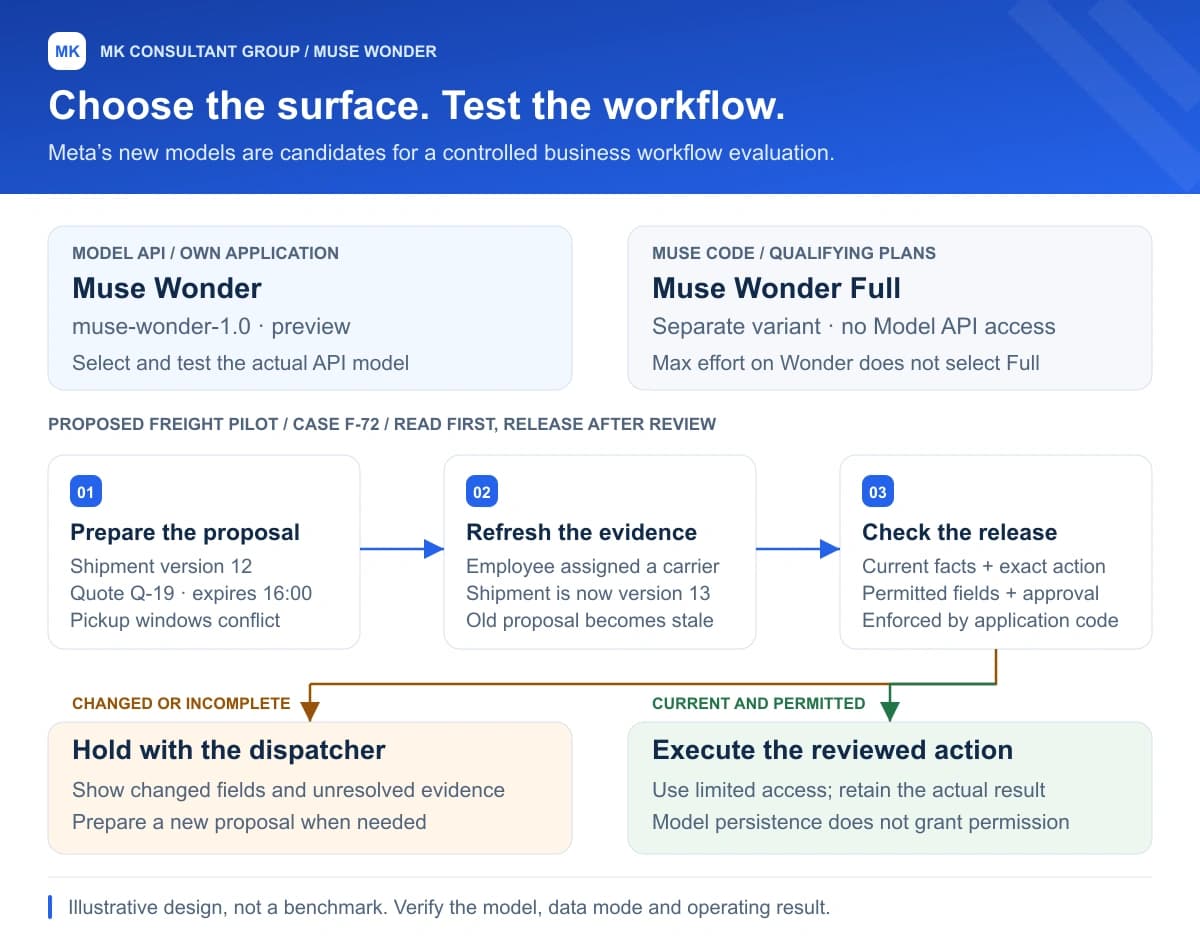
Before sending, retrieve or recheck the facts whose freshness matters and bind approval to the final recipient and wording. If the shipment changes after drafting, the old evidence ledger may no longer justify the update. The webhook article explains the version check that can hold a stale action. Read: late shipment events and stale agent proposals
Citation review establishes what the message can substantiate. It does not by itself authorize sending, reveal every relevant document or confirm that the shipment will follow the plan. For S-204, the bounded next step is a reviewed update that retains the unresolved release, with a named owner for the missing document.