Back to all essays
Process1 min read

Embedded engineering, not slideware

We don't hand you a login. We sit with your ops team, map workflows, and ship in weeks. Then the moat compounds.

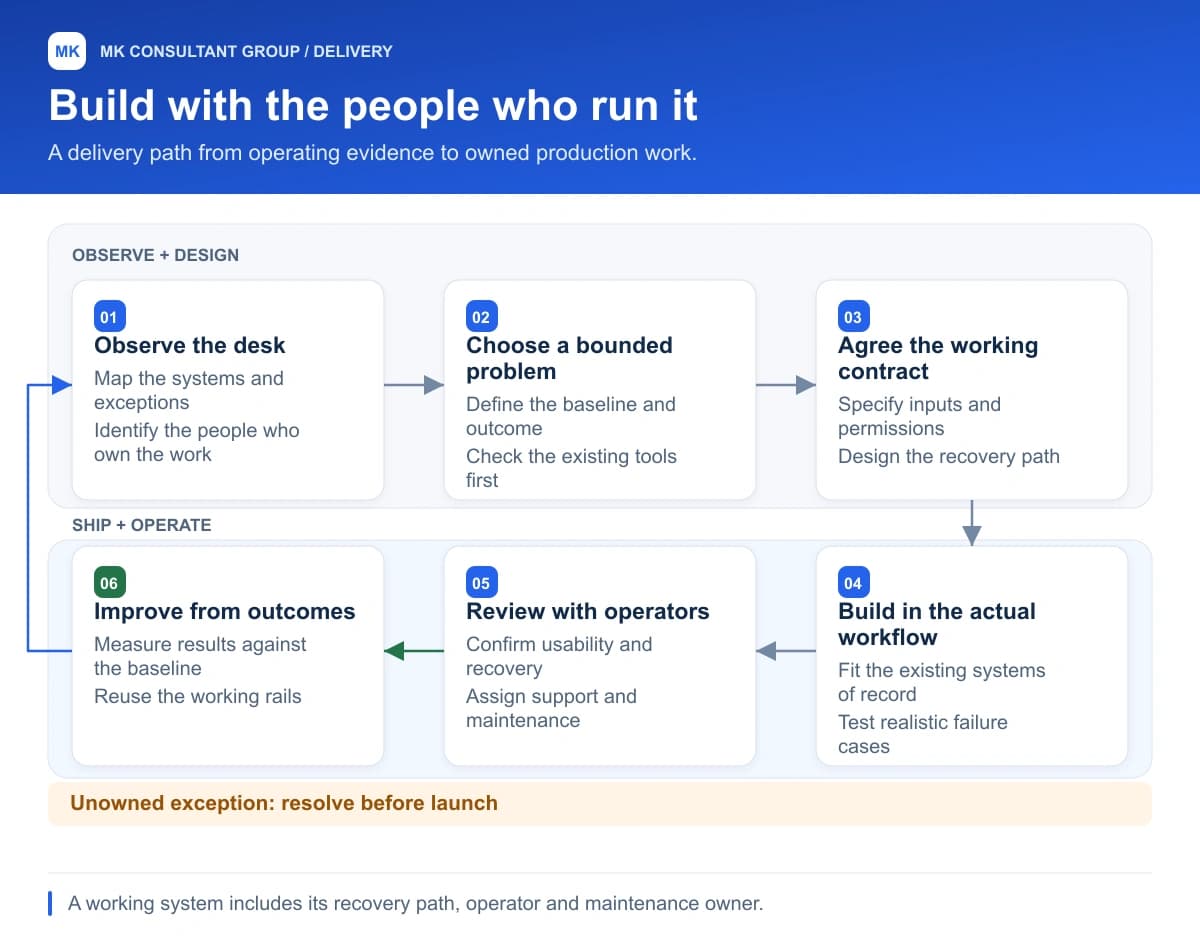
Build with the people who run it. Observe the desk; Choose a bounded problem; Agree the working contract; Build in the actual workflow; Review with operators; Improve from outcomes.
Open full-size workflow diagram
Read the workflow steps
  1. Observe the desk. Map the systems and exceptions. Identify the people who own the work.
  2. Choose a bounded problem. Define the baseline and outcome. Check the existing tools first.
  3. Agree the working contract. Specify inputs and permissions. Design the recovery path.
  4. Build in the actual workflow. Fit the existing systems of record. Test realistic failure cases.
  5. Review with operators. Confirm usability and recovery. Assign support and maintenance.
  6. Improve from outcomes. Measure results against the baseline. Reuse the working rails.
  7. Unowned exception: resolve before launch.
  8. A working system includes its recovery path, operator and maintenance owner.
Cover graphic for Embedded engineering, not slideware, Process

Consulting that ends in a deck is expensive storytelling. You paid for clarity and received a PDF. The operations team still runs the same Monday morning.

Our motion is embed, architect, build, compound. We sit with your ops team. We map the workflows that actually burn time. We ship production systems in weeks. Outcomes show up on the graph. Follow-ups are earned by results, not by calendar persistence.

What embedding looks like

Embedding is not "more meetings." It is access to the desk, the exceptions, the systems of record, and the people who know which rules are real. Without that, architecture is guesswork dressed as strategy.

If your last AI engagement produced slides and a Slack channel, you weren't buying engineering. You were buying comfort.

Compounding starts after the first ship. Every new workflow reuses the rails. Every gated agent improves the next one. That is the opposite of slideware, which resets to zero the moment the projector cools down.
Putting this into practice?