Back to all essays
AI / ML1 min read

Evaluation before enthusiasm

If you can't measure hallucination, latency, and task success, you can't govern an agent. Full stop.

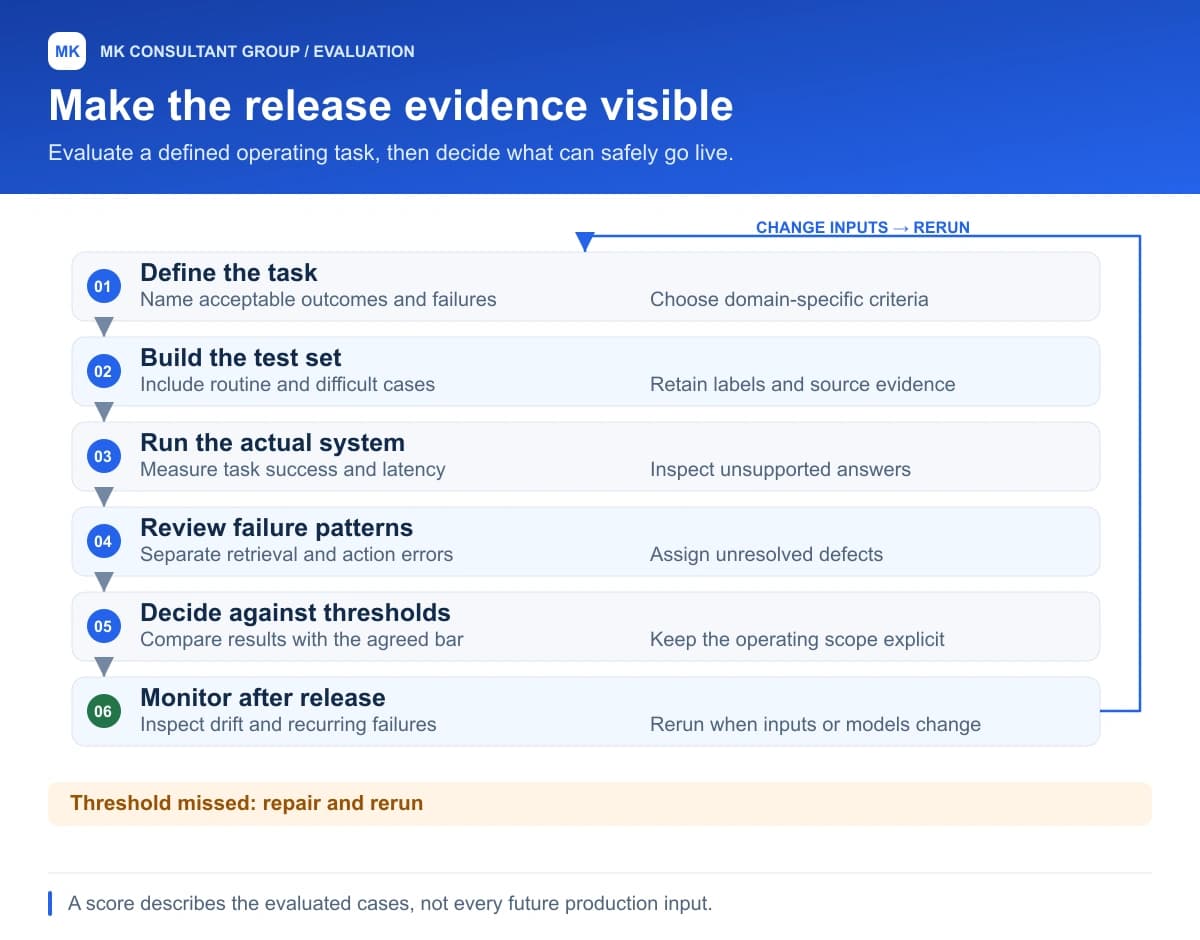
Make the release evidence visible. Define the task; Build the test set; Run the actual system; Review failure patterns; Decide against thresholds; Monitor after release.
Open full-size workflow diagram
Read the workflow steps
  1. Define the task. Name acceptable outcomes and failures. Choose domain-specific criteria.
  2. Build the test set. Include routine and difficult cases. Retain labels and source evidence.
  3. Run the actual system. Measure task success and latency. Inspect unsupported answers.
  4. Review failure patterns. Separate retrieval and action errors. Assign unresolved defects.
  5. Decide against thresholds. Compare results with the agreed bar. Keep the operating scope explicit.
  6. Monitor after release. Inspect drift and recurring failures. Rerun when inputs or models change.
  7. Threshold missed: repair and rerun.
  8. A score describes the evaluated cases, not every future production input.
Cover graphic for Evaluation before enthusiasm, AI / ML

Enthusiasm ships demos. Evaluation ships systems. The gap between those two sentences is where most "AI transformations" go to die, loudly in Slack, quietly in the budget.

Before an agent touches a live desk we instrument task success, latency budgets, and failure modes that matter in that domain. Freight cares about quote validity. Insurance cares about consent and show rate. Energy cares about false curtailment alarms. One generic scorecard will lie to all of them.

Name the failure

Without that harness, "it worked in the meeting" becomes "it failed on Friday at 4pm," and nobody can explain why. You cannot govern what you cannot measure. You cannot improve what you refuse to taxonomy.

If you can't measure hallucination, latency, and task success, you can't govern an agent. Full stop.

Evaluation is not a phase after launch. It is the gate that decides whether launch is honest. We run golden sets, adversarial prompts, and regression suites the same way a serious eng team runs tests on payments code, because outbound agents are payments with words.

Bring enthusiasm to the whiteboard. Bring evaluation to production. In that order, always.
Putting this into practice?