Back to all essays
AI / ML1 min read

Model-agnostic by design

When the next model drops, swap the layer. Keep the business logic. Architecture beats duct tape.

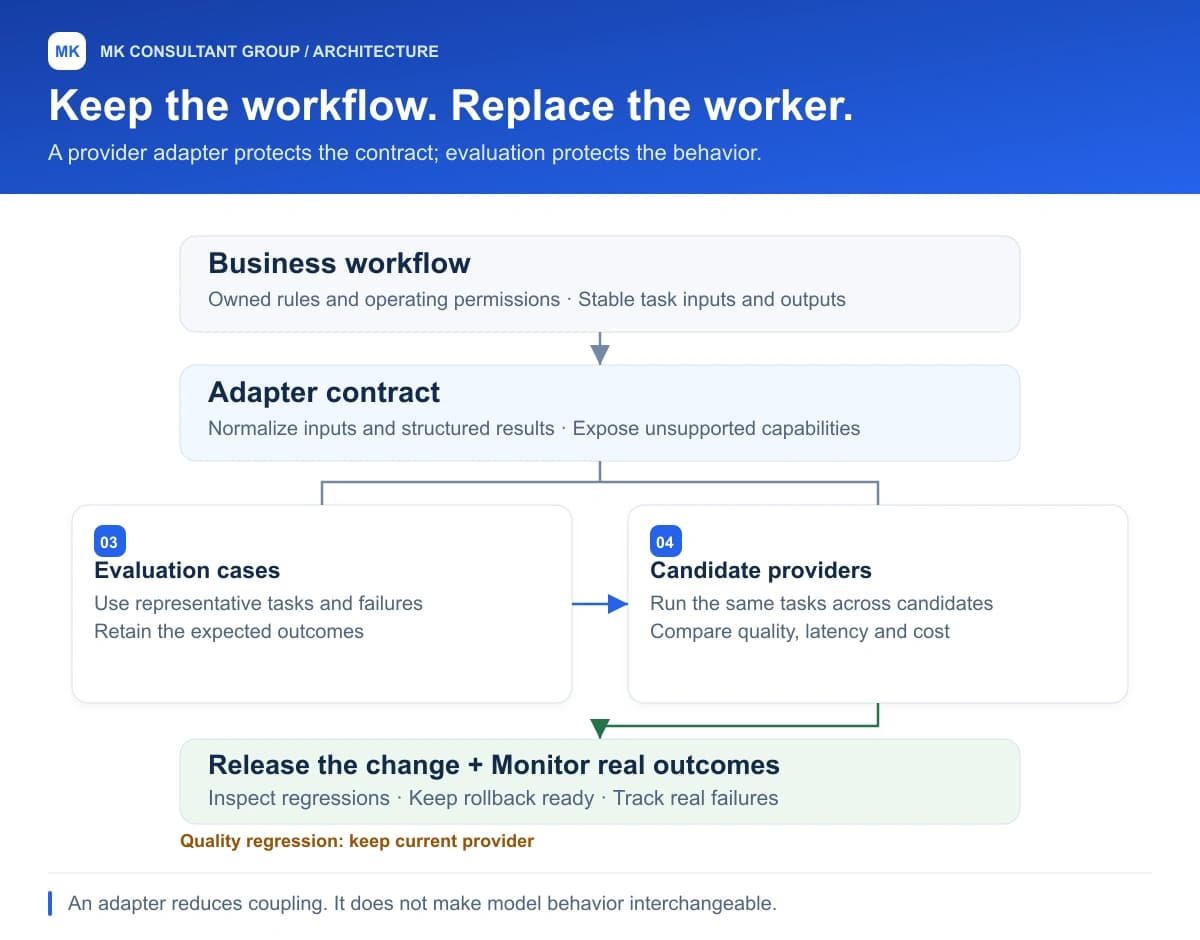
Keep the workflow. Replace the worker.. Business workflow; Adapter contract; Evaluation cases; Candidate providers; Release the change; Monitor real outcomes.
Open full-size workflow diagram
Read the workflow steps
  1. Business workflow. Owned rules and operating permissions. Stable task inputs and outputs.
  2. Adapter contract. Normalize inputs and structured results. Expose unsupported capabilities.
  3. Evaluation cases. Use representative tasks and failures. Retain the expected outcomes.
  4. Candidate providers. Run the same tasks across candidates. Compare quality, latency and cost.
  5. Release the change. Inspect regressions before switching. Keep a tested rollback path.
  6. Monitor real outcomes. Track failures after replacement. Recheck when models change.
  7. Quality regression: keep current provider.
  8. An adapter reduces coupling. It does not make model behavior interchangeable.
Cover graphic for Model-agnostic by design, AI / ML

Betting your company on a single model vendor is how you inherit their roadmap risk, their pricing mood, and their outage calendar. Convenient on day one. Expensive on day four hundred.

We build model-agnostic systems so business logic, pipelines, and integrations survive the next release cycle. The model is a replaceable worker. Your pricing rules, consent flows, and domain tools are the company.

Swap the worker, keep the plant

Every production system we've shipped since 2023 has been upgraded at least twice without a rewrite. That's the difference between architecture and duct tape. Duct tape is a fine demo trick. It is a terrible estate plan.

When the next model drops, you should feel curiosity, not dread.

Abstraction is not academic purity. It is operational freedom: A/B models on the same task, fall back when a provider blips, and negotiate from a position that is not hostage.

If your "AI platform" is a hard-coded SDK path wrapped in a UI, you do not have a platform. You have a dependency with a logo.
Putting this into practice?