Back to all essays
Energy1 min read

Solar IPP revenue protection in the real world

Curtailment detection, BESS optimization, and PREPA-grade compliance. Monitoring that pays for itself.

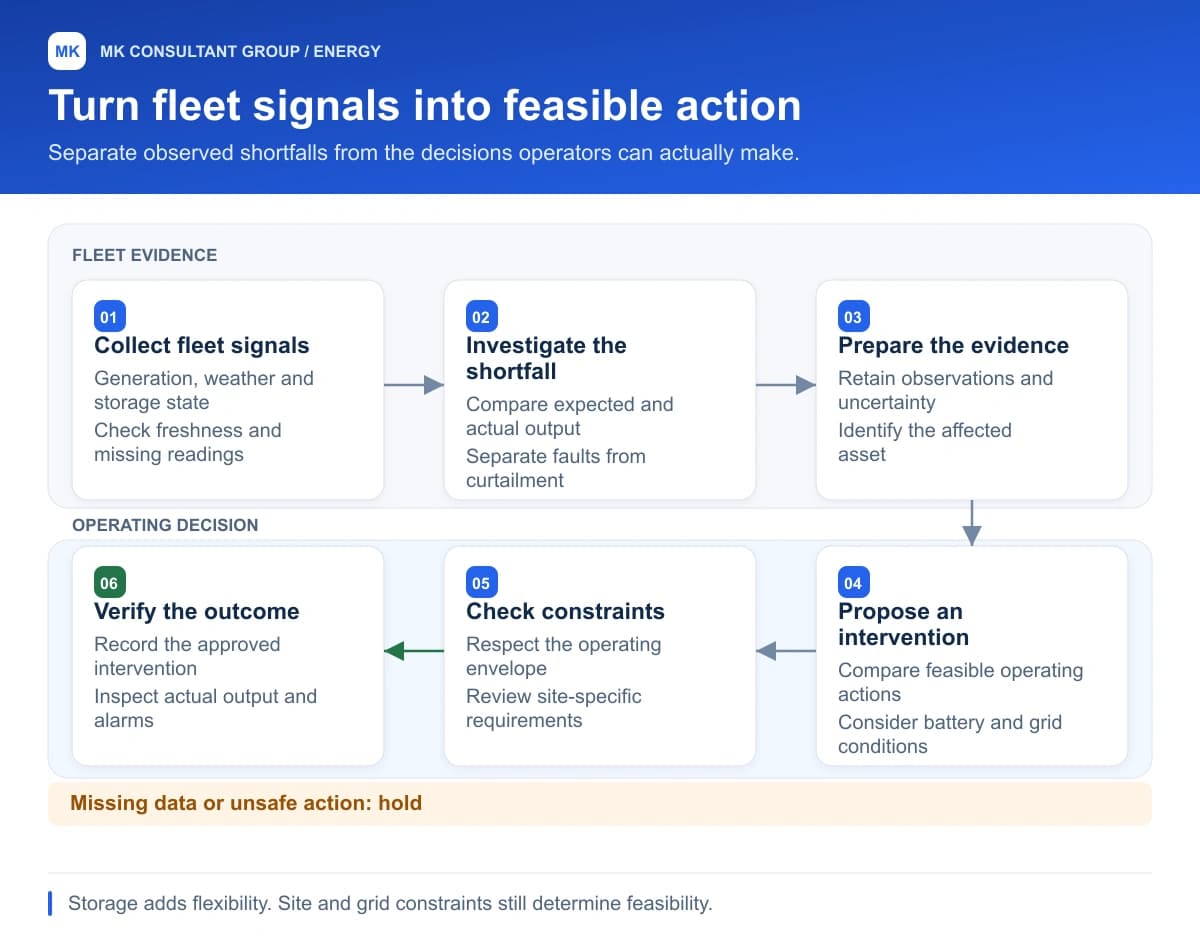
Turn fleet signals into feasible action. Collect fleet signals; Investigate the shortfall; Prepare the evidence; Propose an intervention; Check constraints; Verify the outcome.
Open full-size workflow diagram
Read the workflow steps
  1. Collect fleet signals. Generation, weather and storage state. Check freshness and missing readings.
  2. Investigate the shortfall. Compare expected and actual output. Separate faults from curtailment.
  3. Prepare the evidence. Retain observations and uncertainty. Identify the affected asset.
  4. Propose an intervention. Compare feasible operating actions. Consider battery and grid conditions.
  5. Check constraints. Respect the operating envelope. Review site-specific requirements.
  6. Verify the outcome. Record the approved intervention. Inspect actual output and alarms.
  7. Missing data or unsafe action: hold.
  8. Storage adds flexibility. Site and grid constraints still determine feasibility.
Cover graphic for Solar IPP revenue protection in the real world, Energy

A 100+ MW solar fleet doesn't lose money dramatically. It leaks, quietly and continuously, through curtailment and suboptimal storage dispatch. By the time finance notices, the quarter has already paid for the silence.

Our monitoring systems for solar IPP operations treat revenue protection as a first-class signal, not a weekly spreadsheet. Operators see curtailment patterns early. Storage decisions are grounded in actual grid behavior, not hopeful averages.

PREPA is not a template

PREPA constraints are some of the strictest in the world. Generic "AI energy dashboards" buckle because they were designed for a different regulatory weather. Domain-native systems encode those constraints instead of apologizing for them in a support ticket.

Predictive maintenance and leakage analytics aren't optional extras. They're how you keep committed capital honest.

BESS optimization only works when the model understands both physics and policy. Ignore either and you get beautiful charts that recommend actions the grid will reject, or worse, actions that quietly destroy value.

Revenue protection is an engineering problem with a P&L face. Build for the face finance recognizes, and the engineering stays funded.
Implementation considerations

What to establish before automating operational alerts

Understand data coverage

Map telemetry sources, update intervals and periods of missing data. Distinguish unavailable measurements from actual equipment underperformance.

Evaluate alerts against events

Compare alerts with operator-reviewed events and account for weather, curtailment and maintenance windows. Track false alarms alongside missed incidents.

Keep intervention accountable

Assign each alert a responsible operator and record its resolution. Define escalation and authorization separately from detection, especially for any control action.

Putting this into practice?